Your Technicians Did the Work. Will the Form Survive Review?
The Documents Tell a Story You Can’t See From the Field
Service technicians spend their days in sumps, behind dispensers, and under tank pads — and almost all of them think of their job as the work itself. Test the line. Pressurize the sump. Verify the overfill. Sign the form.
But every test eventually becomes a piece of paper. And that paper is what state inspectors see first. Long before any regulator visits a site to look at the equipment, they’re reviewing the documents your team submitted — and that document review has become its own enforcement layer, with its own failure modes, its own list of common errors, and its own way of producing violations against operators who paid in full for work that was performed correctly.
The good news for service companies is that state regulators have started telling us, in writing, exactly what they look for. Performance evaluation guidance now includes specific lists of the technician documentation errors inspectors are trained to flag. If you’ve never read these lists, your competitors have — and they’re using them to make sure their service reports survive the desk review that happens before any boots hit the ground.
This article walks through the most common technician documentation failures regulators are calling out, why each one matters, and what service companies can do to prevent them from showing up on their own forms.
Why Document Review Has Become the First Line of Enforcement
For most of the history of the UST program, compliance enforcement happened on-site. An inspector showed up, walked the facility, checked the equipment, and wrote up what they found. Documentation existed primarily to support what the inspector saw with their own eyes.
That model has been shifting for years. State agencies have moved more of their oversight into centralized data systems — California’s CERS being the most prominent, but every state with an approved UST program has some version of it — where testing documents and inspection reports get uploaded, reviewed, and cross-referenced against the facility’s compliance history. Inspectors now look at the paperwork before they leave the office, not just after they walk the site.
That shift has two consequences for service companies:
A document that fails review can trigger an inspection that wouldn’t have happened otherwise.
A document that passes review can become a defense against violations alleged later, because the file shows the work was performed correctly and on time.
Either way, the form is no longer just a record of the work. It is the work, from the regulator’s perspective. A technician who completes a flawless field test but submits a flawed form has done flawed work as far as the inspector is concerned.
The Documentation Errors Regulators Are Actively Flagging
Drawing from publicly available state inspector guidance, here are the specific technician documentation issues regulators have been trained to identify and cite:
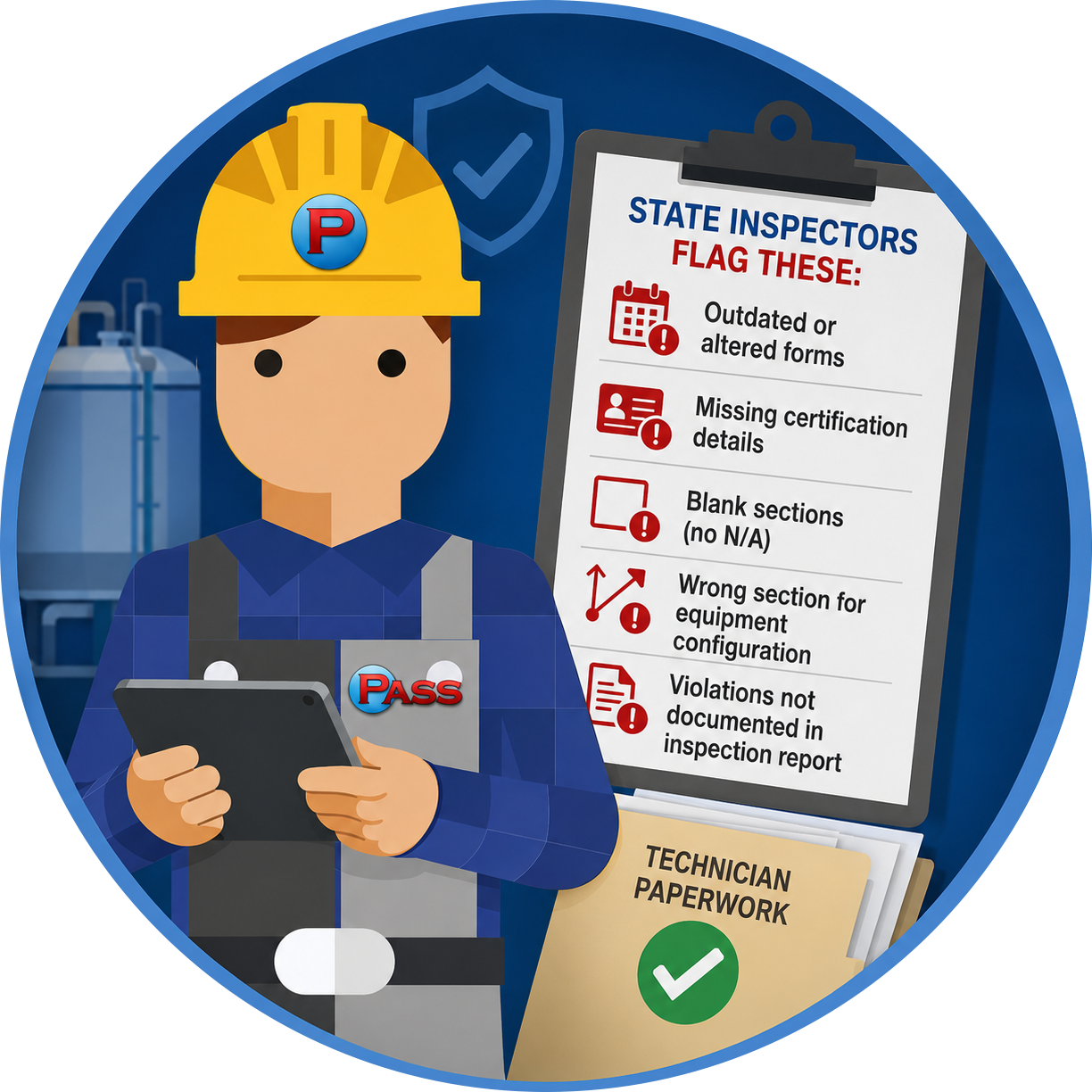
Use of outdated or unofficial forms. Inspectors are instructed to accept only current UST reporting and inspection forms that the state has officially released and approved, and to reject any forms that are modified or outdated. This is one of the most common reasons a service report gets bounced back to the operator. A service company carrying a homemade template, a competitor’s form that got photocopied at some point, or an old version of the state form from two revisions ago will see those submissions rejected — even when the underlying work was performed correctly. Operators are then left with a missed compliance deadline that wasn’t their fault.
Missing certification numbers and expiration dates. Inspectors verify that the technician’s ICC number and expiration date — along with manufacturer and test equipment training certifications — are listed on the testing documents, and that all expiration dates are later than the inspection date. The failure mode here is subtle: a technician may have been current when the work was scheduled but expired by the time the test was actually performed. The form looks complete. The certification looks valid. But the dates don’t line up, and the document gets rejected. Service companies that don’t track certification expirations against work scheduling are exposed to this every time a certification approaches its renewal window.
Blank sections on the testing form. Inspectors are trained to flag testing documents that contain missing or inaccurate information, including blank sections. Anything left blank — even a section that doesn’t apply to the equipment at the facility — gets cited. The correct practice is to write “N/A” in any section that doesn’t apply. A blank field reads, to a reviewer, as an incomplete inspection, regardless of what the technician intended.
Wrong section completed for the equipment configuration. One of the specific errors regulators have called out is the in-tank gauging testing section being completed on the Monitoring System Certification form when the facility actually has double-walled tanks. State forms branch based on the equipment present at the site — and taking the wrong path through the form produces a document that looks complete but represents the wrong test for the equipment. A double-walled tank requires interstitial monitoring documentation, not in-tank gauging documentation. A technician unfamiliar with the form’s logic can produce a fully signed, fully filled-out form that documents the wrong thing entirely.
Findings in the testing paperwork that don’t appear in the inspection report. When testing documents identify non-compliance during the inspection but that non-compliance is not documented in the inspection report or the state’s data system, inspectors are required to document all instances as violations — even if the issue was promptly corrected. A technician who found a problem, fixed it on the spot, and didn’t note it as a finding has created a paperwork mismatch that an inspector will catch on review. The fix is to document what was found, document what was done about it, and let the corrective action speak for itself rather than trying to make the form look cleaner than the actual visit was.
Modified or altered testing documents. Some state inspector guidance specifically calls out instances of unified program agencies accepting unofficial UST testing documents that have been altered by the service technician. Any modification of an official form — adding fields, removing fields, changing formatting — is grounds for rejection. The form is the form. If a technician thinks a section is poorly designed or missing important information, the correct path is to flag it through the service company’s quality process and let the company submit feedback to the state, not to modify the form in the field.
Forms completed by unqualified personnel. Inspector guidance also covers Monitoring System Certification forms completed by a technician with no training or certification provided for the specific test performed — for instance, a technician who is certified for some categories of work but completes the line leak detector test section without the corresponding certification. This is a workforce planning issue masquerading as a documentation issue. Sending a technician to a site without verifying they hold the specific certifications required for every test being performed exposes both the service company and the operator.
Why These Errors Persist
Most of these failure modes are not technical. They are procedural and organizational. The technician knew how to do the work. The form was filled out. The job got billed. But the document failed review because of something upstream of the technician’s actual skill.
A few common root causes:
Form management is decentralized. Forms live on individual laptops, in trucks, in old email attachments. When the state updates a form, there is no central process to push the new version to every technician’s device — so old versions stay in circulation for months or years.
Certifications are tracked in HR, not in dispatch. The person scheduling the work doesn’t know which certifications each technician holds or when those certifications expire. Work gets assigned based on availability, not credential mix.
Field training emphasizes the work, not the form. Senior technicians teach junior technicians how to perform the test correctly. Form completion is treated as administrative overhead rather than as part of the deliverable.
Post-visit review is rare. Most service companies have a process for reviewing technical exceptions — a failed test, a piece of equipment that needs replacement — but no equivalent process for reviewing documentation quality before the form is submitted to the operator or the state.
Each of these is fixable. None of them are fixed by hiring better technicians. They’re fixed by treating documentation as a deliverable with its own quality control process, separate from the technical work.
Practical Steps for Service Companies
The following steps map directly to the regulator findings above. Service companies that implement these can substantially reduce their document rejection rate and protect their operator clients from violations that originate in paperwork rather than performance.
Centralize form distribution. Identify one person in the organization who is responsible for monitoring state UST program websites for form updates, downloading the current versions, and distributing them to every technician’s device. When a state publishes a new revision, the old revision is removed from circulation the same day. Build a quarterly audit into the schedule — every quarter, verify that the forms on every technician’s device match the current state-published versions.
Sync certification tracking with dispatch. Move certification expiration tracking out of HR spreadsheets and into the dispatch system. Every job assignment should be validated against the certifications required for the specific tests being performed. If a technician’s certification expires before the scheduled work date, the dispatch system should flag it before the truck rolls.
Train technicians on form logic, not just form completion. Field training should cover not just how to fill out each section, but the branching logic of the form — which sections apply to which equipment configurations, and which sections should be marked N/A versus left blank versus completed. A short reference card in the truck listing the most common configuration-to-section mappings can prevent the in-tank gauging-on-a-double-walled-tank error.
Build a same-day documentation review. Before any service report leaves the field, have a second set of eyes review it for the specific items inspectors flag: form version, certification numbers and dates, completed vs. blank sections, equipment-to-section alignment, and consistency between the testing document and the service summary. This can be a quick checklist in the service company’s job management system, but it has to happen on the same day as the work — not at end-of-week, when memory of the visit has already faded.
Document corrective actions explicitly. When a technician finds and fixes an issue during the visit, document both the finding and the corrective action on the form. Don’t try to make the form look cleaner than the visit was. A documented finding-plus-correction is a stronger compliance posture than a clean form that doesn’t match the testing record.
Treat the form as a deliverable. Every service company has internal standards for what a “good job” looks like in the field. Build an equivalent standard for what a good service report looks like. Audit a sample of completed reports each month against that standard, identify the technicians whose documentation drifts most often, and provide targeted coaching. Documentation quality is a trainable skill, and it’s substantially cheaper to train than to recover from a rejected submission.
What This Means for Service Companies in 2026 and Beyond
The regulatory direction of travel is clear. State programs are investing in better data systems, more standardized forms, and more rigorous document review. The space between “the work was performed correctly” and “the documentation will survive review” is widening. Service companies that close that gap turn routine maintenance visits into a defensible compliance record. Service companies that don’t will find themselves explaining to operators why a passed test produced a failed inspection.
The technicians doing the work are not the problem. Most of them are exceptional at what they do. The opportunity is in the systems around them — form management, certification tracking, post-visit review — that determine whether their work translates into documentation that holds up.
PASS Symphonics was built specifically for service companies facing exactly this challenge. Symphonics centralizes form management so every technician is working from the current state-approved version of every form. It ties certification tracking to job dispatch so work is only assigned to technicians whose credentials match the scope. It captures testing documentation, service reports, and corrective actions in one record, with built-in review workflows that catch documentation gaps before forms leave the field. And it produces a defensible audit trail for every service event, organized in a way that maps to what state inspectors actually look for during document review.
If your team is spending time chasing down old forms, rebuilding rejected submissions, or explaining to operators why a passing test produced a failing inspection, Symphonics is worth a conversation. Contact us today.
Sources
California State Water Resources Control Board — Underground Storage Tank Facility File Review performance evaluation guidance: inspector training on common technician documentation errors, including outdated forms, missing certification information, blank sections, equipment-to-section mismatches, and undocumented findings.
California State Water Resources Control Board — UST regulations update effective January 1, 2026, requiring service technicians to use the most recent state-approved forms when performing inspections and testing.
Maryland Department of the Environment, Oil Control Program — Certified UST System Inspector Reference Handbook (May 2023): documentation standards and inspection report requirements.
International Code Council — UST/AST Credentialing Program: certification structure and renewal requirements referenced by state programs.