Your ATG Is Running. Your Compliance Isn’t.
The Quiet Gap Between Owning Monitoring Equipment and Actually Using It
Every UST owner with a modern automatic tank gauge can point to the console on the wall and say their site is “being monitored.” The lights blink. The probe is in the tank. The system runs a test on its own schedule. The equipment is doing its job.
But the equipment isn’t the compliance. The records are.
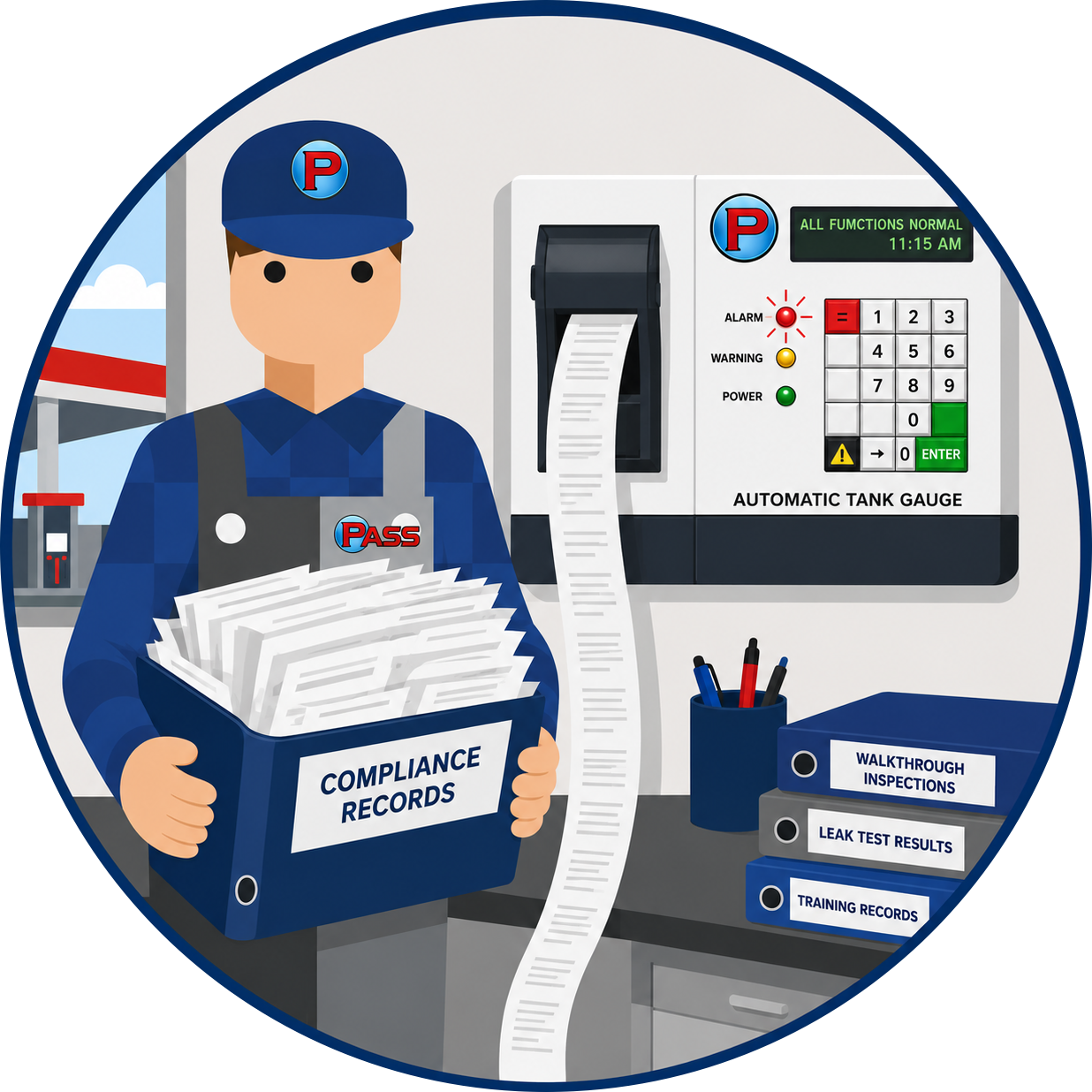
The single most common pattern in UST enforcement — across single-site independents and multi-site chains alike — is the operator who has working monitoring equipment but cannot produce the documentation to prove the equipment was working when the regulator showed up. The leak detection happened. The test passed. The alarm cleared. None of that matters if the printout isn’t in the file.
This article is for owners and operators who want to close that gap. We’ll walk through what the rules actually require, where compliance most often falls apart, and how the shift toward remote and continuous monitoring is changing what “in compliance” looks like in 2026 and beyond.
What the Rules Actually Say About Monitoring
The foundation hasn’t changed since the 2015 EPA rule took full effect. Release detection is required monthly for every regulated UST. Owners and operators must obtain at least one passing test result for each tank every 30 days, and they must keep records that prove it.
The federal framework recognizes several monitoring methods: interstitial monitoring with secondary containment, automatic tank gauging, statistical inventory reconciliation, continuous in-tank leak detection, groundwater monitoring, and vapor monitoring. Tanks of 2,000 gallons or less may also use manual tank gauging if they meet specific requirements.
For tanks installed or replaced after April 11, 2016, the rules narrowed. Those tanks must be secondarily contained and use interstitial monitoring as the primary release detection method. Standalone ATG-based in-tank detection no longer qualifies as the primary method on newer installations, even though the ATG still plays a central role in collecting and reporting sensor data.
Layered on top of release detection are the recordkeeping requirements that came online in October 2018:
• Three years of records for spill bucket testing, containment sump testing, and overfill inspections.
• One year of records for walkthrough inspections, performed every 30 days for spill prevention and release detection equipment, and annually for containment sumps and hand-held equipment.
• Records demonstrating compliance with operator training requirements.
• Records demonstrating fuel compatibility for tanks storing greater than 10 percent ethanol, greater than 20 percent biodiesel, or other regulated substances identified by the implementing agency.
States routinely add their own requirements on top. Some require monthly compliance inspections rather than walkthroughs. Some require shorter cathodic protection inspection intervals. Some restrict which release detection methods are acceptable. The federal rules are the floor, not the ceiling.
Where Monitoring Compliance Falls Apart
Owners and operators who get cited for release detection violations rarely fail because the equipment wasn’t installed. They fail in much more specific and avoidable ways:
The monthly check happens but nobody pulls the printout. The ATG is running a leak test on its own schedule and storing the result internally. If nobody retrieves and files that result every 30 days, the test result might as well not exist. An inspector asking for the last 12 months of leak detection records will see a binder with gaps, and gaps are violations — even if the underlying tests all passed.
Alarms get silenced without investigation. An alarm came in, somebody hit the acknowledge button, the console went quiet. No investigation was performed, no follow-up was logged. That cleared alarm is now a documented event with no documented resolution. Inspectors trained on ATG records know how to spot this pattern, and “alarm acknowledged without resolution” is a violation category in itself.
Sensor faults go unaddressed. A sump sensor reports a fault. The ATG flags it. Nobody fixes it. The next monthly leak test runs anyway, but the result is now unreliable because part of the monitoring system isn’t actually monitoring. Walkthrough inspection records that don’t reflect known sensor faults compound the problem.
The ATG is doing the test, but the wrong test. Many ATG consoles can be configured to run different types of leak tests at different sensitivity levels. A console that’s set to run an inventory-tracking calculation rather than a certified 0.2 gph leak test will produce reports that look like compliance but don’t satisfy the regulatory requirement. Owners often inherit these configurations from prior owners or prior service vendors and never realize the setting is wrong.
Walkthrough inspections happen, but only in someone’s head. The 30-day walkthrough is one of the most under-documented requirements in the entire UST program. A store manager who actually walks the site every month is doing the work, but if there’s no signed and dated walkthrough form on file, the work doesn’t count for compliance purposes.
The records exist, but nobody can find them. Records in three different places — some on the ATG printer, some in a desk drawer at the store, some in an email folder at corporate — fail to satisfy the requirement that records be “readily available” during an inspection. A facility that takes 45 minutes to assemble its leak detection file during a walkthrough is heading for a finding.
The fuel compatibility records were never created. Sites that switched to higher-blend ethanol or biodiesel after the 2015 rule took effect were required to begin keeping compatibility documentation. Many never did, because the fuel switch was treated as a supply decision rather than a compliance decision.
None of these failures requires bad equipment or bad intent. They require the absence of a clear, repeatable monitoring routine — and the absence of someone whose actual job is to make sure the routine is running.
What Remote and Continuous Monitoring Changes
The category of technology that’s reshaping owner/operator compliance the fastest is remote ATG polling — systems that pull data automatically from the on-site ATG console, transmit it to a central platform, store it on a schedule, and generate compliance reports without any store-level intervention.
For owners and operators, the practical implications are substantial:
The monthly leak test record creates itself. Instead of relying on a store employee to print and file the report, the report is captured automatically at the source and stored in a system the operator can access from anywhere. The “we forgot to pull the printout” failure mode goes away.
Alarms generate notifications, not just console messages. A leak alarm or sensor fault that used to sit silent until someone happened to look at the console now triggers an email, text, or platform notification to a compliance manager — usually within minutes of the event. The window between “something happened” and “somebody knows about it” collapses from weeks to minutes.
Documentation is centralized by default. Records from every site live in one place, organized by site, with timestamps that an inspector can verify. The “records exist but nobody can find them” failure mode is fundamentally solved by architecture rather than by discipline.
Compliance trends become visible. When monthly leak test results from every site flow into one system, patterns emerge that no individual site manager would ever see. A specific tank that’s been borderline for six months. A sensor that fails its monthly test more often than the others. A site whose walkthroughs are always submitted late. These patterns are the early warning signs of bigger problems — and they’re invisible without aggregated data.
Multi-site operators get apples-to-apples reporting. A chain operator with 40 sites no longer has to ask 40 store managers to do 40 different versions of the same paperwork. The data structure is consistent across the portfolio, which makes audit response, insurance documentation, and acquisition due diligence dramatically easier.
For single-site operators, remote monitoring removes the burden of being the person who has to remember everything. For chain operators, it removes the variance that comes from managing compliance across dozens or hundreds of independent decision-makers. The compliance posture stops depending on whether the right person was on shift the day the regulator showed up.
Practical Steps for Owners and Operators
Whether you’re operating a single site or a hundred, the same principles apply. The goal isn’t perfect equipment — it’s a defensible record that demonstrates the equipment was working, the tests were passing, and the issues that came up were resolved.
Audit your last 12 months of records before an inspector does. Pull the binder. Pull the digital folder. Make sure every month is represented with a passing leak test result for every tank. Identify gaps now, when you can address them, rather than during an inspection.
Walk the ATG console with someone who knows it. Verify the leak test mode is set correctly. Verify the sensitivity threshold matches your regulatory requirement (typically 0.2 gph for tanks). Verify alarm settings are active and routed to someone who will respond. Verify the printer is working and stocked.
Make walkthrough inspections a documented routine, not an informal habit. Use a checklist. Sign and date it. File it. If your state has its own walkthrough form, use that one. If not, build a form that captures every required item and stick to it.
Centralize records, even if you only have one site. A single binder at the site is fragile. A single digital folder synced to cloud storage is durable. A platform that captures records automatically is better still. Pick the level that matches your operation — but don’t rely on records scattered across multiple locations.
Treat alarms as compliance events, not nuisances. Every alarm needs a documented resolution. “Acknowledged” is not a resolution. Even a clearly false alarm needs a note: who looked at it, what they determined, when the issue was cleared, and any corrective action taken. This documentation protects you later if a regulator questions whether you responded appropriately.
Know which tests you owe and when. Build a calendar that covers every recurring test: monthly leak detection, annual line tightness (if applicable), triennial sump and spill bucket testing, annual operability testing of release detection equipment, and any state-specific cycles. Then assign each one to a responsible party with a deadline. Compliance is project management as much as it is engineering.
Plan for the records to outlive the staff. Store managers turn over. Service vendors change. The records have to remain accessible regardless of who’s currently on payroll. Build systems that survive personnel changes — because the regulator’s three-year lookback doesn’t care who used to work at the site.
What This Means for Owner/Operators in 2026
The direction of UST monitoring is clear. State programs are investing in centralized data systems, more frequent inspections, and tighter scrutiny of the records owners are required to keep. The federal floor isn’t moving much, but the practical expectations around documentation and responsiveness are rising every year. Operators who run their compliance programs on the assumption that paperwork is a once-a-year sprint are exposed in ways that operators who run continuous, documented monitoring are not.
The technology to close that gap exists today and is more accessible than it has ever been. Remote ATG polling, automated compliance reporting, alarm notification, and centralized record storage are no longer enterprise-only capabilities reserved for large chains. They are available to independent operators, fleet operators, marinas, municipal sites, and multi-site chains on terms that scale to the size of the operation.
PASS ATG Connect was built for exactly this. It connects to the ATG console you already own, automatically captures the leak detection and inventory data the console is producing, stores it in a central platform, and generates the compliance documentation regulators ask for. Alarm events trigger notifications so issues get addressed in real time rather than discovered weeks later. Records are organized by site, by tank, and by test type — ready for an inspector, an insurance audit, or a due diligence request, without anyone having to dig through a desk drawer.
If your compliance program depends on someone remembering to pull a printout, file a binder, or check a console every 30 days, ATG Connect is worth a conversation. Contact us today.
Sources
U.S. Environmental Protection Agency — Operating and Maintaining UST Systems: 2015 Requirements: walkthrough inspection requirements, recordkeeping cycles (three-year and one-year), and operability testing of release detection equipment.
U.S. Environmental Protection Agency — Release Detection for Underground Storage Tanks (USTs): Introduction: federal release detection requirements, accepted methods, and the post-April 11, 2016 requirement for interstitial monitoring on new and replaced UST systems.
3U.S. Environmental Protection Agency — Automatic Tank Gauging Systems for Release Detection: Reference Manual for Underground Storage Tank Inspectors (EPA 510-B-00-009): specifications, calibration requirements, and inspector evaluation criteria for ATG-based release detection.
U.S. Environmental Protection Agency — Resources for UST Owners and Operators: fuel compatibility recordkeeping requirements for higher-blend ethanol and biodiesel, and operator training documentation requirements.
Colorado Division of Oil and Public Safety — UST Operation guidance: state-level requirements illustrating how implementing agencies extend the federal framework (monthly compliance inspections, cathodic protection inspection intervals, suspected release reporting timelines).