Annual or Triennial? The Answer Depends on the Test and the State
Ask two operators how often a spill bucket has to be tested and you may get two different answers. The frustrating part is that both can be right. One runs sites in a state that follows the federal baseline. The other runs sites in a state that decided the federal baseline was not enough.
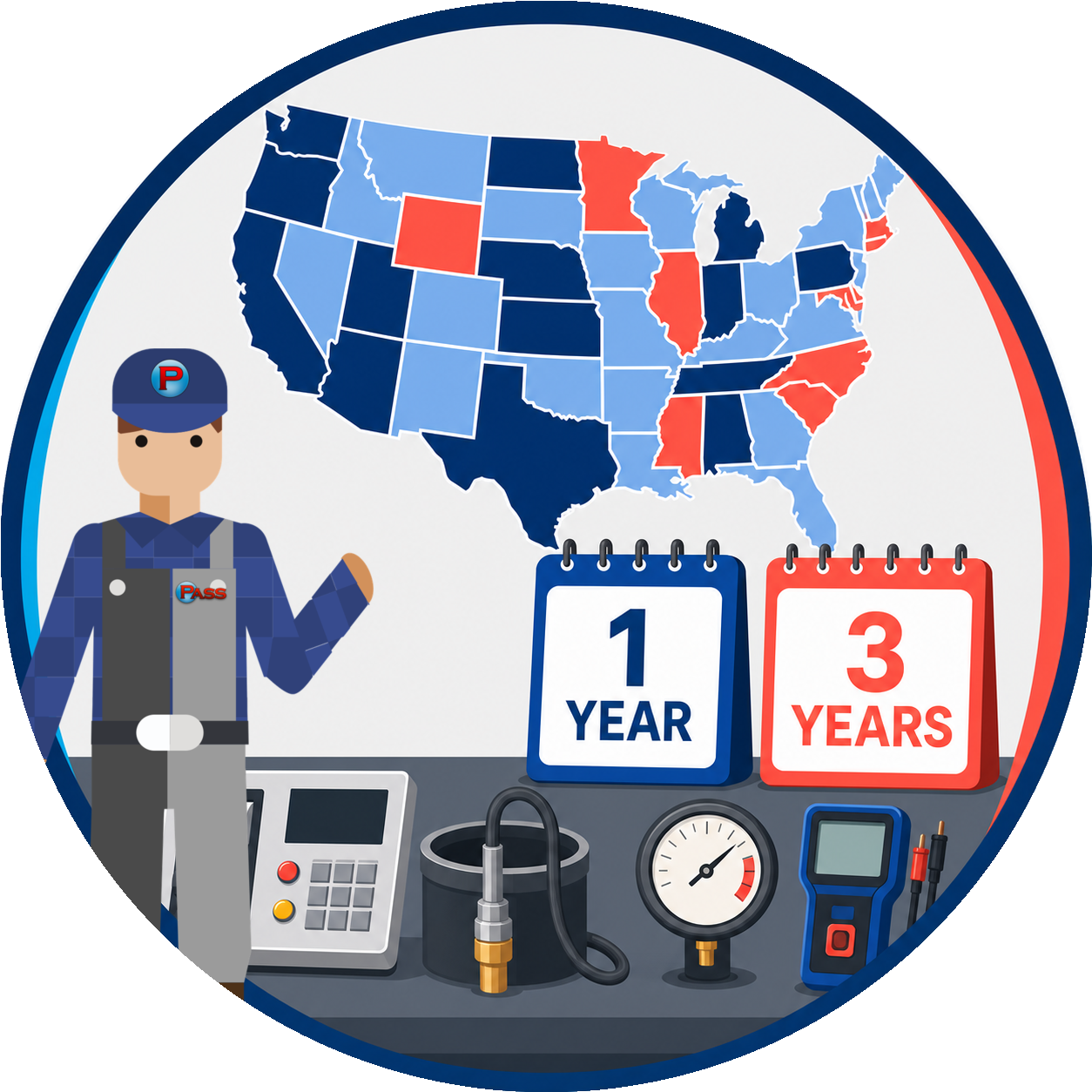
That is the trap. Most operators carry a single mental calendar for testing and inspection, and they apply it to every piece of equipment on every site. But the required cycle is not one number. It changes with the test type, and it changes again with the state. Get it wrong by testing too often and you are burning money on visits the rule never asked for. Get it wrong by testing too rarely and you are sitting on a violation that an inspector will find the moment they pull your records.
What the federal rule actually says
The federal floor for underground storage tanks lives in 40 CFR Part 280, and it is more varied than “test everything once a year.” It sets different clocks for different equipment.
Cathodic protection systems must be tested within six months of installation and at least once every three years after that, under 40 CFR 280.31(b). Spill prevention equipment, overfill prevention equipment, and containment sumps used for interstitial monitoring of piping must be tested for operability or liquid tightness at least once every three years, under 40 CFR 280.35. Release detection equipment such as automatic tank gauges, sensors, and line leak detectors must be evaluated for proper operation annually, under 40 CFR 280.40. And the operation and maintenance walkthrough inspection runs on its own short clock: spill prevention equipment gets a look every 30 days, with a broader walkthrough at least annually, under 40 CFR 280.36.
Read those together and the pattern is clear. There is no single federal testing cycle. There is a triennial clock, an annual clock, a monthly clock, and an event clock, and each applies to a specific category of equipment. That is the baseline. Then the states go to work on it.
The same test, a different cycle across the state line
States that run their own UST programs are allowed to be stricter than the federal rule, and many are. Here is how the major test types actually break down once state divergence enters the picture.
Cathodic protection surveys. Federal cycle: every three years. Several states require an annual survey instead, including states like Florida, New York, Connecticut, and Maine. Same test, same equipment, three times the frequency depending on where the tank sits.
Spill and overfill prevention. Federal cycle: every three years. Mississippi is the clean example of a state going the other way. Its DEQ program requires annual testing and annual inspection of spill and overfill equipment, documented on the state form, so an operator who runs on the federal three-year assumption is two years behind on every site in the state.
Stage I vapor recovery. Federal cycle: the NESHAP floor is triennial. This is where the divergence is widest. California, Texas, and Rhode Island require annual testing. Texas spells it out at 30 TAC 115.225, which calls for annual static pressure and pressure/vacuum vent valve testing using the CARB TP-201.3 and TP-201.1E procedures. An operator treating vapor recovery as a three-year item in Texas is under-testing by design.
Containment sump testing. Federal cycle: every three years for the tightness test under 280.35. The catch is that the three-year tightness test is a different obligation from the visual sump check inside the 30-day and annual walkthrough. They are not interchangeable, and passing one does not satisfy the other. Operators routinely collapse the two and end up short on the test that carries the real liability.
Release detection and ATG. Federal cycle: annual under 280.40. This one is closer to uniform across states, which is exactly why it is easy to over-generalize from it. Because the ATG check is annual, operators assume everything is annual. It is the single biggest source of the “one calendar” mistake.
Tank and line tightness. Federal cycle: there is no standing annual requirement for most modern systems; it is largely event-driven, triggered by installation, repair, or a suspected release. But some states layer a recurring cycle on top. New York, for instance, imposes periodic tightness testing that the federal rule does not, while Tennessee keeps tightness testing event-driven only. Two states, opposite conclusions, same equipment.
 UST Compliance Tools
UST Test Cycle Lookup
A PASS Training & Compliance tool. The federal floor for every major UST test, with its CFR citation, plus the state rules PASS has read out of each state's own regulation. All 50 states and DC are covered, though not every test is verified in every state. Pick your state to see where it runs stricter than the federal cycle. Add a second state to compare side by side.
No state chosen yet. The table below is the federal floor: what 40 CFR Part 280 requires everywhere, before any state adds to it.
- Stricter State requires the test more often than the federal cycle.
- At federal State rule verified, and it lands on the federal cycle.
- State-added A requirement with no federal counterpart in this data set.
- Not cataloged PASS has not verified a state rule for this test here. Federal floor shown.
Swipe the table sideways to see every column →
| Test type | Federal cycle | Citation |
|---|
Three steps that keep the calendar honest
Knowing the divergence exists is not the same as managing it. Three moves turn it into a system.
First, know your state, site by site. If you operate across state lines, you are not managing one testing program. You are managing a different one for each state, and the differences are not cosmetic. Pull the actual state rule or state form for every jurisdiction you touch.
Second, map each test to its own cycle. Do not carry one calendar. Build a matrix: every test type down one axis, every state down the other, with the required interval in each cell. That is the only view that shows you where you are over-testing and where you are exposed.
Third, calendar it and drive from the test date. A cycle only protects you if the next-due date is computed from the last test date and flagged before it lapses, not discovered during an inspection. Early testing, end-of-month drift, and state-form conventions all move the real deadline, so the calendar has to track the document, not a rule of thumb.
The Bottom Line
There is no universal UST testing cycle, and treating one as if it exists is how compliant operators end up with violations and cost-conscious operators end up over-spending. The federal rule sets four different clocks, and the states reset several of them upward. The required cycle is a function of two variables, the test and the state, and both have to be right on every site. The operators who stay clean are the ones who stopped guessing and started mapping.
That mapping is exactly what PASS Harmonics was built to carry: it tracks each test cycle against the correct state rule, computes the next-due date from the actual test date, and flags what is coming before it lapses, so one calendar per state stops being something you hold in your head. If you are running multi-state and reconciling cycles by memory, that is the place to start.
Not sure which cycles apply to the states you operate in? Ask us.