Storm Season Does Not Test Your Tanks. It Tests Your Records.
A hurricane does not care whether your underground storage tank system is in compliance. It will lift a half-empty tank out of the ground with the same indifference whether your permits are current or three years lapsed. The regulator who inspects the site afterward, on the other hand, cares about almost nothing else.
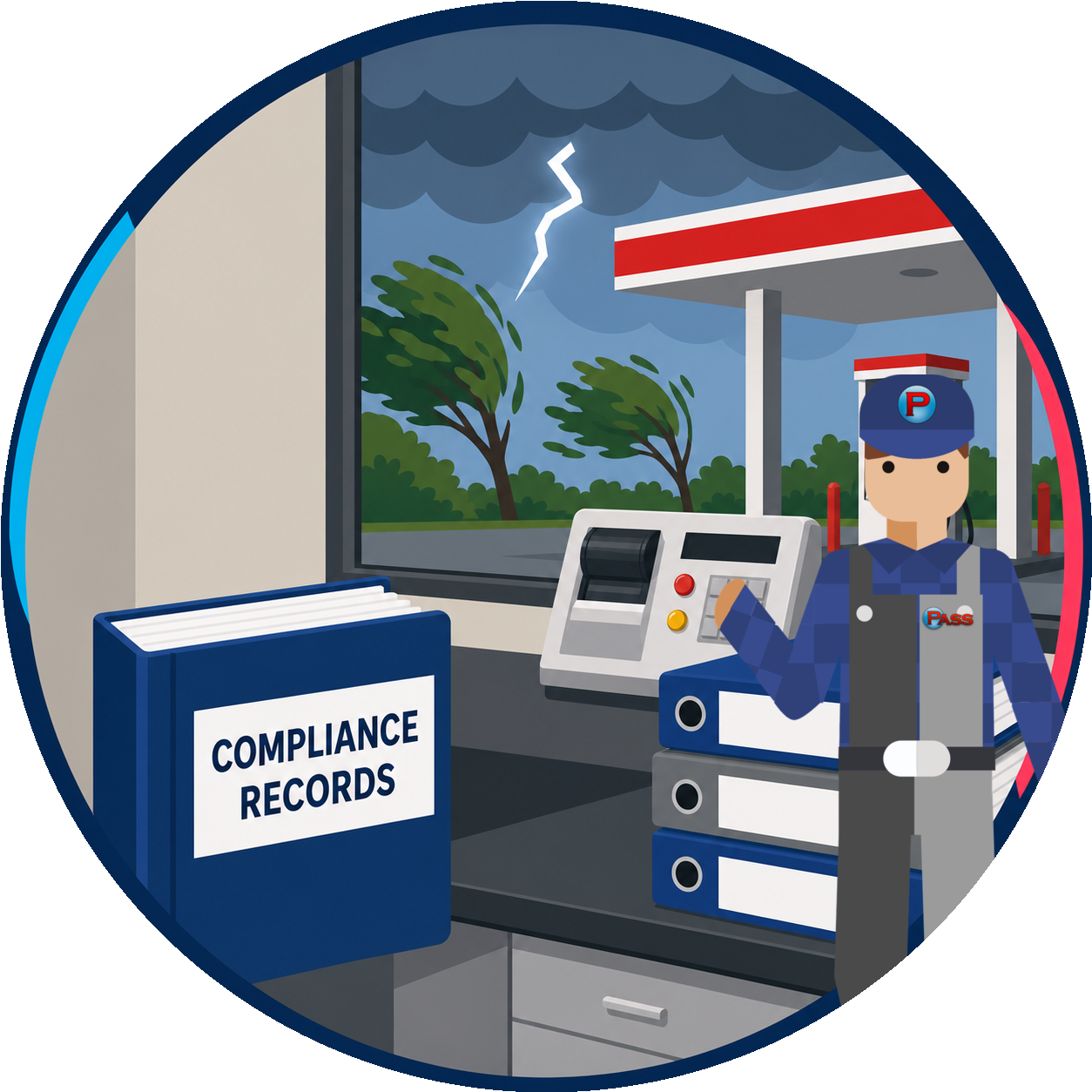
That is the quiet paradox of storm season. The forecast feels like an emergency, something outside your normal operation that demands heroics. But look closely at what EPA actually asks you to do before a storm, and almost every item is something the tank rules already expected of you. Preparedness is not a separate discipline bolted on when the sky turns. It is your everyday compliance, done a few days early and under pressure.
For UST owners and operators, August and September are when that truth gets tested. Here is how EPA frames the work, and why the operators who come through a storm cleanest are the ones whose records were already in order before the first band of rain.
The Emergency Kit You Need Is a Filing Cabinet
Most storm-prep talk fixates on the physical: sandbags, plywood over dispensers, a tank filled heavy enough to resist buoyancy. Those steps matter, and we will get to them. But the item that determines whether a post-storm return to service goes smoothly is not in your maintenance shed. It is your documentation.
When floodwater recedes and local officials allow re-entry, EPA is blunt about the standard: before returning a damaged tank to service, the owner or operator needs to ensure the system has been properly evaluated and restored to safe operating condition. Proving that requires a baseline. What were your product and water levels before the storm? What did release detection show? When was cathodic protection last tested? An operator who can answer those questions from a clean record resolves the event in days. An operator who cannot is stuck reconstructing history while the tank sits idle and the implementing agency waits.
What EPA Actually Recommends
EPA’s “Natural Disasters and Underground Storage Tanks” resource does not cover only floods. It addresses tornadoes, hurricanes, tsunamis, earthquakes, volcanic eruptions, fires, and severe weather, and it points to specific guidance for each: the Underground Storage Tank Flood Guide, a Wildfire Guide for underground and aboveground systems, recommended actions for fire-impacted facilities, and a post-severe-weather checklist. The common thread across all of them is a before, during, and after structure built around one goal: prevent a release, and be able to prove you did.
The flood checklist, EPA 510-F-23-003, is the most detailed and the best template for storm season generally. Here is its before-the-storm catalog, verbatim in substance:
Inspect the facility to find areas susceptible to flooding and the consequences if it happens, and assess the predicted extent and duration.
Turn off power to all UST systems, including submersible turbine pumps, dispensers, and pumps. Keep the release detection system on as long as power is available.
Take product inventory and water level readings of all tanks. This is your baseline.
Reduce the chance of a tank rise. Weigh the tank down with heavy objects or sandbags, or fill it with fuel to counter buoyancy. If flooding is predicted to be excessive, consider instead minimizing fuel to lessen the volume of a potential release. Do not fill tanks with water.
Secure the openings. Make sure fill caps are operable, place sandbags over spill catch basins and sump lids, confirm spill bucket plunger seals work, and temporarily cap vent pipes to keep water out.
Isolate the piping. Have a technician drain product lines back into the tank, close flow restrictors, and manually trip shear valves on pressurized piping.
Protect the aboveground equipment. Cover or, if time allows, remove dispensers, and shield controls from floodwater and floating debris.
Address any remediation system. Shut off its power, disconnect and remove portable trailers, and cap remediation wells.
Read that list again as a compliance officer, not a maintenance lead. Item 2 is your release-detection obligation, kept running exactly when it matters. Item 3 is the inventory reconciliation you should already be doing. The whole sequence is your normal duty of care, compressed and prioritized.
 UST Compliance Tools
Storm-Season Readiness Tracker
A PASS Training & Compliance tool, built on EPA's UST flood checklist (EPA 510-F-23-003). Work through the three phases and tick off each step. Your progress saves in this browser, and the finished list prints clean.
You have completed 0 of 21 readiness steps.
Once water recedes and officials allow re-entry.
Who do you notify? Find your implementing agency.
The level check above ends at your state's UST implementing agency. Pick your state for the release-reporting page and the published phone number.
On tribal lands, EPA is the implementing agency.
Two companion downloads go with this checklist: the one page UST Storm Prep Checklist (PDF) to post in the office, and the fillable Post Storm Return to Service Record (PDF) that turns your after storm inspection into a dated compliance record.
What to Do This Week, Before the Forecast Turns
You cannot execute an eight-step storm protocol from a standing start while a hurricane is 36 hours out. The preparation that counts happens now, in calm weather.
Pull your baseline into one place. Current inventory and water readings, last tightness and line tests, cathodic protection results, and active permits. If gathering these takes more than an afternoon, that is the gap the storm will find.
Confirm release detection is live and logged. The during-storm instruction is to keep it running. That only helps if it was working and recording beforehand.
Know your implementing agency’s requirements cold. EPA defers to your state agency on emergency response, release notification, restarting a system, and component testing. Have those contacts and thresholds documented before you need them.
Write down your after-storm plan. EPA’s return-to-service standard hinges on comparing pre and post levels. A discrepancy triggers release notification. Decide now who measures, who documents, and who files.
The Bottom Line
Storm season does not hand UST operators a new set of obligations. It reveals, under the worst possible conditions, whether you were meeting the ones you already had. The tank that floats, the water that gets in, the release that goes unreported: each is a compliance failure that a storm made visible, not one it created. The operators who weather August and September are not the ones with the most sandbags. They are the ones who can produce a clean baseline on the way in and a documented restoration on the way out.
EPA’s framework is free and public. Preparedness, it turns out, is just compliance with a deadline attached.
For deeper flood-specific mechanics, see our earlier pieces, the UST Flood Guide and Flood Risks Are Rising, Is Your UST System Ready. This piece is about the readiness that sits underneath all of it.
Keep your storm-season baseline where you can find it in 36 hours. PASS Harmonics centralizes inventory, testing schedules, permit deadlines, and compliance records in one cloud repository, so the documentation EPA expects after a storm is already assembled before one forms. When the forecast turns, your baseline is a login away, not a scramble. Learn more at passtesting.com.
Questions about storm-season compliance at your own sites? Talk to us.