Every compliance task in this newsletter traces back to one law. The Resource Conservation and Recovery Act, or RCRA, turned 50 on October 21. President Ford signed it in 1976, and EPA marked the date last week.
The tank rules came later, in layers. Each layer is still on your to-do list. Here is how they stacked up, and what EPA's new reform push means for owners right now.
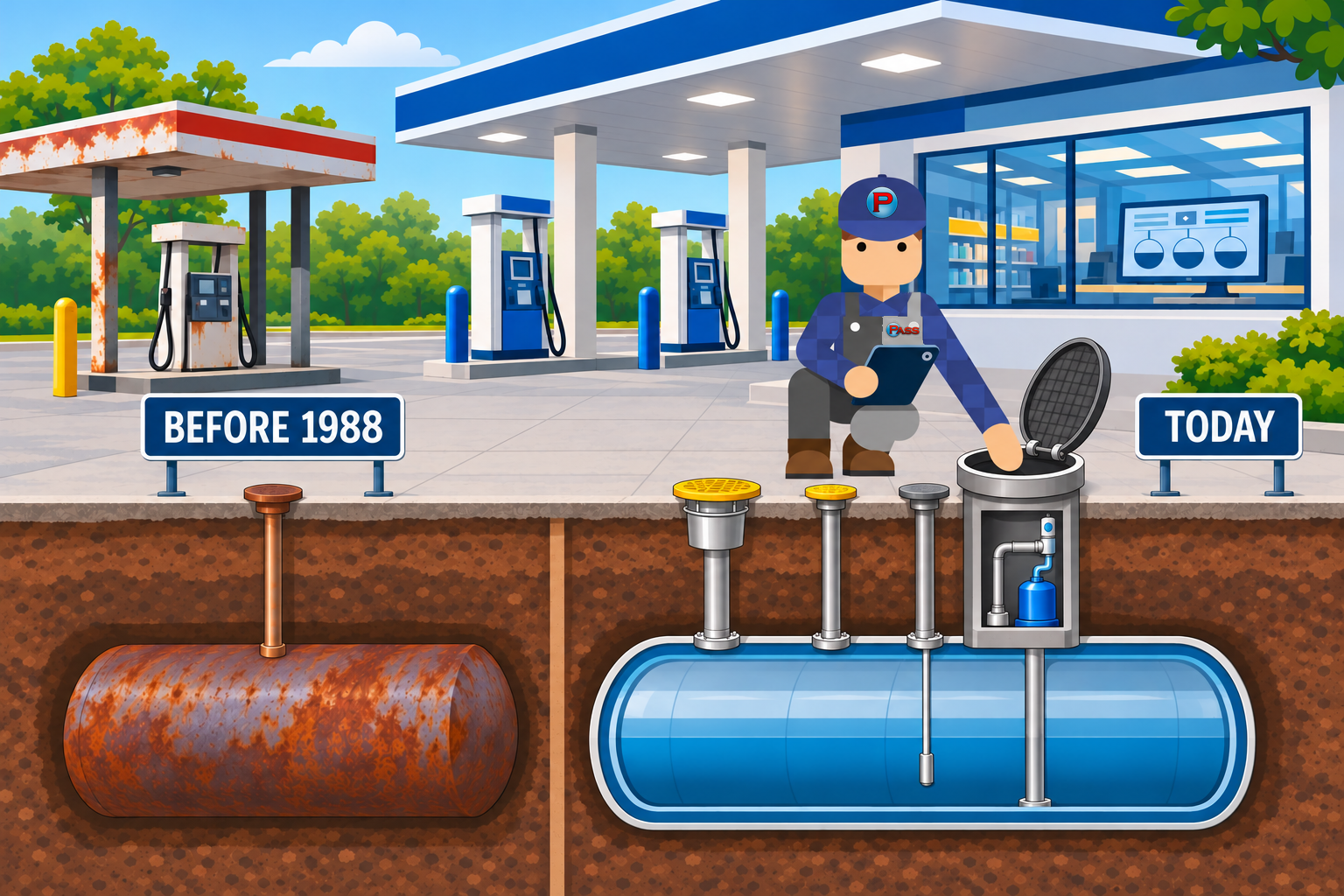
How the Rulebook Was Built
1976: RCRA becomes law. Congress set national rules for solid and hazardous waste. Underground tanks weren't in it yet.
1984: Tanks get their own program. In November 1984, Congress added Subtitle I. It told EPA to set rules for tank design, leak detection, spill and overfill control, cleanup and closure. At the time, most tanks were bare steel, which corrodes. In 1986, Congress created a trust fund for leaking tank cleanups. It also told EPA to make owners show they could pay for a cleanup.
1988: The first federal tank rules. EPA published them in September 1988. Tanks installed after December 22, 1988 needed corrosion protection and spill and overfill equipment. Leak detection phased in by tank age from 1989 to 1993, oldest tanks first.
1998: Upgrade or close. By December 22, 1998, every older tank had to meet the new-tank standards, be upgraded or be closed. Upgrading meant corrosion protection plus spill and overfill equipment.
2005: Congress raises the bar. The Energy Policy Act of 2005 required every regulated tank to be inspected every three years. It also had EPA write guidelines for states on operator training and delivery prohibition. Delivery prohibition means stopping fuel deliveries to a tank that is out of compliance.
2015: The rules you run today. EPA's 2015 revision was the first major change since 1988. It added the walkthrough inspection and a yearly test of release detection equipment. It added checks every three years for spill buckets, some containment sumps and overfill equipment. It also made operator training federal: every site needs designated Class A, B and C operators. Most of it applied by October 13, 2018.
Each card below shows what an era changed and what it still asks of you.
 UST Compliance Tools
50 Years of RCRA
How the federal tank rules were built, one layer at a time. Pick a year to see what changed and what it still asks of you today.
1976
RCRA becomes law

What changed
President Ford signed the Resource Conservation and Recovery Act on October 21, 1976. It set national rules for solid and hazardous waste. Underground tanks were not in it yet.
What it asks of you today
Nothing on its own. It is the law the tank program was later added to.
Source: EPA, History of RCRA.
1984
Tanks get their own program

What changed
In November 1984, Congress added Subtitle I. It told EPA to set rules for tank design, leak detection, spill and overfill control, cleanup and closure. Most tanks then were bare steel, which corrodes. In 1986, Congress added a trust fund for leaking tank cleanups and told EPA to require proof that owners can pay for one.
What it asks of you today
Your tanks are regulated, usually through your state's program. States can be stricter than the federal rules.
Source: EPA, Learn About Underground Storage Tanks.
1988
The first federal tank rules

What changed
EPA published the rules in September 1988. Tanks installed after December 22, 1988 needed corrosion protection and spill and overfill equipment. Leak detection phased in by tank age from 1989 to 1993, oldest tanks first. Owners also had to show they could pay for a cleanup.
What it asks of you today
Monitor your tanks for leaks at least every 30 days (40 CFR 280.41). Keep proof you can pay for a cleanup.
Sources: EPA, 1988 UST rule page; 40 CFR 280.12, 280.40 (July 2014 edition), 280.41.
1998
Upgrade or close

What changed
By December 22, 1998, every tank installed before 1989 had to meet the new-tank standards, be upgraded or be closed. Upgrading meant corrosion protection for steel tanks and metal piping, plus spill and overfill equipment.
What it asks of you today
A tank that was never upgraded must be closed. A tank upgraded by lining needs an internal inspection within 10 years of lining, then every 5 years (40 CFR 280.21).
Sources: 40 CFR 280.21 (July 2014 edition and today's text).
2005
Congress raises the bar

What changed
The Energy Policy Act of 2005 required every regulated tank to be inspected every three years. It had EPA write guidelines for states on operator training, inspections, delivery prohibition and secondary containment.
What it asks of you today
Expect an inspection at least every three years. Operator training, one of its topics, became a federal rule in 2015.
Sources: EPA, Learn About Underground Storage Tanks; EPA, 2015 UST rule page.
2015
The rules you run today

What changed
EPA's first major revision since 1988. It added walkthrough inspections, periodic tests of equipment, and federal operator training. Most of it applied by October 13, 2018.
What it asks of you today
- Walkthrough every 30 days: spill buckets and release detection. Once a year: sumps and hand-held gear (280.36).
- Test release detection equipment once a year (280.40).
- Every 3 years: test spill buckets and sumps used for piping leak detection, and inspect overfill equipment (280.35).
- Keep designated Class A, B and C operators (280.240).
Sources: EPA, 2015 UST rule page; 40 CFR 280.35, 280.36, 280.40, 280.240.
2026
50 years, and a cleanup push

What changed
EPA started Common Sense RCRA Reform. For tanks, the goal is a faster pace of cleanups. A September 2025 EPA policy encourages states to re-check open releases by real exposure risk. EPA counted 534,189 active tanks and 52,859 releases still open in March 2026.
What it asks of you today
If you have an old open release, gather your records: release report, site reports, sampling results, site map. Every prevention rule on the cards before this one still applies.
Sources: EPA OUST announcement, Oct 22, 2026; EPA policy statement, Sept 2025; EPA UST performance measures, March 2026.
Where This Issue's Other Stories Fit
Two of this month's stories are 2015 rules at work.
The 30-day walkthrough. Every 30 Days or Monthly? shows how a same-date schedule runs a day late.
Alarms. The walkthrough's check for alarms and the yearly test that your gauge's alarm works both date from 2015. Not Every ATG Alarm Is an Emergency covers what to do when one goes off.
The Numbers After 50 Years
OUST Director Carolyn Hoskinson put the count at "over 533,000 LUST sites" cleaned up. LUST stands for leaking underground storage tank. She also counted more than half a million active tanks in use today.
EPA's March 2026 report backs that up: 534,189 active tanks at about 190,000 facilities. It also listed 52,859 releases still waiting for cleanup. That open pile is where the new push aims.
What the Reform Push Means for You
EPA's new strategy is called Common Sense RCRA Reform. Most of it is about hazardous waste. Two of its six goals reach tanks: renew the pace of cleanups, and retain protection for health and the environment.
If you have an old open release. In September 2025, OUST issued a policy statement. It encourages state agencies to re-check open release sites by real exposure risk. The questions are simple. Is the contamination still moving? Can it reach people, wells or buildings?
A site that is stable and can't reach anyone may be rated low threat. EPA says a low-threat site may not need more cleanup and can be moved to closure. These reviews usually use data already collected, with no new field work. EPA is also working with ASTM on training for its standard on moving sites to closure. The aim is to focus on higher-risk sites and get stalled low-risk sites moving.
So if a release on your property has sat open for years, your state may take a fresh look. Get your file ready before anyone calls:
The release report: where, when, how much and what product.
Site assessment and closure reports.
Soil and groundwater sampling results, and the trend over time.
A site map showing nearby wells, buildings and utilities.
EPA's exposure checklist, built for its own project managers, asks for exactly those items. Ask your cleanup consultant or state project manager whether your site is a candidate. A review can cut both ways. It can also find a threat nobody saw before.
The prevention rules are not loosening. Nothing in the announcement changes the day-to-day rules. Walkthroughs, leak detection, periodic tests, operator training and records all stand. The policy statement says it does not change any law or regulation.
Read it yourself. The policy statement (PDF), the exposure evaluation checklist (PDF) and EPA's RCRA page.
The Bottom Line
Fifty years built the rulebook in layers, and every layer still applies. The new push is about cleanups, not prevention. If you have an old release on file, pull your records together now. Either way, keep your walkthroughs and tests on schedule.
Not sure which of these rules your state enforces, or how? Ask us.